




A rejected personal loan application can feel like a dead end — particularly when you need funds urgently for medical expenses, home renovation, debt consolidation, or a family event. However, a rejection is not a final answer but a diagnostic signal. Understanding what the rejection tells you about your financial profile and taking systematic steps to address each identified weakness creates a clear path to loan approval. This guide covers every practical next step after a personal loan rejection in India. 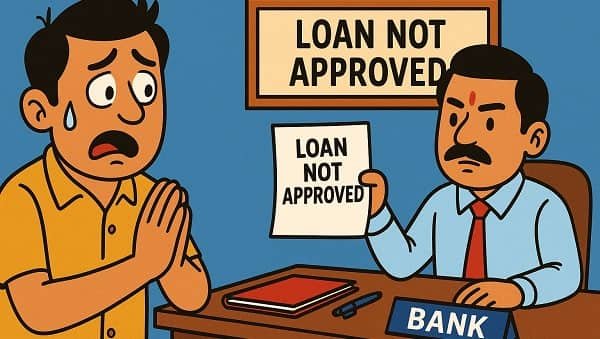
Step 1 — Obtain and Understand the Rejection Reason
The most important immediate step after rejection is obtaining the specific reason from the lender in writing. While banks are not legally obligated to provide detailed rejection explanations for unsecured personal loans, most will provide a general reason if asked directly. Common reasons provided include insufficient credit score, income not meeting eligibility criteria, existing debt obligations too high, incomplete documentation, or applicant not meeting specific lender criteria for employment type or employer category. If the lender provides a vague reason, ask specifically whether the rejection was credit-score-related — this determines your entire next course of action.
Step 2 — Review Your Credit Report Immediately
Obtain your free credit report from CIBIL at cibil.com — every individual is entitled to one free report per year. Review the report systematically for the following: your current CIBIL score and the key factors pulling it down; any loan accounts showing default or late payment markers; credit card accounts with high utilisation percentages; any loan or credit accounts you do not recognise that may indicate identity theft or data error; and previously settled accounts that may be creating negative impressions with lenders. If you find errors — which are more common than most people realise — file a dispute with CIBIL providing supporting documentation. Credit bureaus must investigate and respond within 30 days. Successfully removing incorrect negative entries can significantly improve your score relatively quickly.
Step 3 — Assess Your FOIR and Debt Position
Calculate your current Fixed Obligation to Income Ratio by adding all existing EMIs (home loan, car loan, other personal loans, credit card minimum payments) and dividing by your net monthly take-home income. If this ratio exceeds 50%, most lenders will not approve an additional personal loan regardless of your credit score. To reduce FOIR, identify loans that can be closed early or credit card balances that can be paid down — even partial reduction improves your FOIR and your overall creditworthiness.
Step 4 — Consider a Different Lender or Loan Product
Different lenders have different eligibility criteria. If a public sector bank rejected your application, a private bank may approve it. If a private bank rejected it, an NBFC may have more flexible criteria. Digital lending platforms — licensed by RBI — often have lower minimum credit score requirements and more flexible income documentation acceptance. Salary advance loans, gold loans, and loans against fixed deposits are secured alternatives that are significantly easier to obtain than unsecured personal loans and can serve immediate financial needs while you rebuild your credit profile for an unsecured loan.
Step 5 — Apply for a Smaller Loan Amount
If your rejection was income or FOIR-related rather than credit score-related, applying for a smaller loan amount — one whose EMI clearly fits within your remaining income capacity — significantly improves approval probability. Once approved and repaid successfully, your enhanced credit profile supports applications for larger amounts. Start with an amount whose EMI does not exceed 20–25% of your net monthly income even if your actual requirement is larger.
Step 6 — Add a Co-Applicant or Guarantor
Adding a co-applicant with strong credit history and stable income substantially strengthens a personal loan application. A co-applicant’s income is added to yours for eligibility calculation, and their good credit history compensates for weaknesses in your own profile. Spouses, parents, or siblings are common co-applicants. Both co-applicants are equally liable for the loan repayment — ensure your co-applicant clearly understands this responsibility before proceeding. A guarantor — who is liable only if you default — is a slightly different arrangement that some lenders accept as an alternative to a co-applicant.
Step 7 — Explore Alternative Funding Sources
While working on your loan eligibility, consider alternative funding sources for immediate needs. Employer salary advance loans — available through many companies — are interest-free or low-interest and do not affect your credit profile. Provident fund partial withdrawal is available for specific approved purposes including medical emergencies and housing needs. Credit union or cooperative society loans may have more flexible terms than commercial banks. Borrowing against life insurance policy surrender value or against fixed deposits provides secured funding at significantly lower interest rates than personal loans, with guaranteed approval regardless of credit profile.
Building a 6-Month Improvement Plan
For those with significant credit score or income documentation issues, a realistic 6-month improvement plan can transform a rejected applicant into an approved borrower. Month 1: obtain credit report, identify and dispute errors, close unused credit cards with zero balances, set up autopay for all EMIs. Months 2–4: maintain perfect payment discipline, work with CA on income documentation if self-employed, consider a secured credit card to build positive payment history. Months 5–6: check updated credit score, calculate improved FOIR, identify the most appropriate lender for your profile, prepare complete documentation, apply with confidence.
Frequently Asked Questions
Q: How quickly can I improve my CIBIL score after improving payment behaviour? A: Credit bureaus typically update records monthly — consistent on-time payments for 6–12 months can raise a score by 50–100 points depending on the starting point and the specific negative factors present. Q: Is it better to apply to multiple lenders simultaneously after rejection? A: No — each application triggers a hard inquiry that temporarily reduces your score. Apply strategically to one lender at a time, allowing 60–90 days between applications. Q: Can I get a personal loan immediately after a rejection elsewhere? A: Immediately reapplying is not recommended. However, if you apply to a lender with explicitly different eligibility criteria — such as an NBFC with lower credit score minimums — and your rejection was not score-related, a second application within a few weeks may be reasonable. Q: What is a secured credit card and how does it help build credit history? A: A secured credit card is issued against a fixed deposit — typically requiring ₹10,000–₹50,000 as collateral. Using it for small regular purchases and paying the full bill monthly creates a positive payment history in your credit report within 6–12 months, improving your CIBIL score.