


Unicharm’s Indian unit posted revenue of ₹3,612 crore in FY23, with its diaper segment alone contributing ₹3,022 crore against P&G’s comparable diaper business of ₹2,422 crore, a genuine reversal of fortunes in a category Pampers dominated with a 56% share as recently as 2013. This ranking of the top 10 diaper manufacturers in India 2026 tracks that competitive shift, alongside the domestic challengers and e-commerce-native brands now eating into a market where no single company holds more than 25-30% of total value.
1. Unicharm Corporation (MamyPoko)
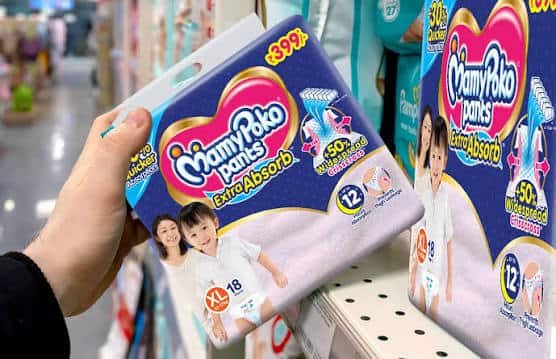
Unicharm’s Indian revenue climbed to ₹3,612 crore in FY23, with the diaper segment accounting for 84% of that total, or ₹3,022 crore, according to the company’s Registrar of Companies filing, reflecting 35% annual growth over the past decade. The company pioneered pant-style diapers in India and has continued innovating with its proprietary “Crisscross Absorbent Sheet” technology, preventing bulkiness while ensuring up to 12 hours of absorption, and announced plans in February 2025 to establish a third Indian manufacturing facility specifically to boost production capacity by roughly 30%.
That capacity expansion signals genuine confidence in sustained demand growth, and market share data from April-December 2023 showing MamyPoko at 38.2% against Pampers’ 40.3% illustrates just how tight this competition has become, a dramatic shift from the 56% Pampers commanded in 2013 when Unicharm held only 18% share.
2. Procter & Gamble (Pampers)
Pampers’ Indian diaper business generated ₹2,422 crore, representing about 29% of P&G’s total India business, and the brand maintained a 40.3% market share during April-December 2023 even as MamyPoko closed the gap to 38.2% over the same period. The company has focused strategically on a “skin-health” narrative, launching its Premium Care and Pure Protection lines with clinically proven anti-rash properties targeting India’s growing premium urban demographic that prioritises hypoallergenic, chlorine-free materials.
That premium positioning strategy reflects P&G’s deliberate choice to defend margin and high-end market share rather than compete purely on volume against Unicharm’s more aggressive mass-market and Tier-II city expansion, a genuinely different competitive approach that’s kept Pampers’ revenue base meaningfully smaller than MamyPoko’s despite comparable market share.
3. Kimberly-Clark (Huggies)
Huggies has historically held a considerably smaller share of India’s diaper market, cited at around 8% in earlier competitive assessments, positioning it as the third major multinational player behind the closely matched Unicharm and P&G. The brand is known for its proprietary DryTouch layer and clinical certifications, and Kimberly-Clark Lever, the joint venture structure controlling Huggies in India, continues investing in comfort-focused product features including bubble bed softness and triple leak guard technology.
That smaller market share, relative to the two dominant multinationals, reflects Huggies’ genuinely narrower positioning within India specifically compared to its considerably stronger global standing in markets like the United States, though the brand continues maintaining a meaningful presence through consistent product innovation and marketing investment.
4. Nobel Hygiene
Nobel Hygiene’s in-house Teddy brand held approximately 5% market share in earlier competitive assessments, positioning the company as the leading domestic Indian challenger among the multinational-dominated diaper landscape, alongside its adult incontinence-focused Friends brand. The company represents one of the strongest domestic manufacturers effectively challenging multinationals specifically in value-tier segments, where price sensitivity gives Indian-manufactured alternatives a genuine cost advantage over imported or premium-positioned multinational products.
Nobel Hygiene’s continued relevance across both baby diapers and adult incontinence products gives it a genuinely broader hygiene product portfolio than pure baby-diaper specialists, positioning it to benefit from India’s ageing population trends alongside its traditional infant care business.
5. Millennium BabyCares (Bumtum)
Millennium BabyCares represents a genuine digital-first success story, with its Bumtum brand achieving explosive growth specifically through e-commerce channels rather than traditional retail distribution, leveraging platforms like Amazon India and Flipkart to reach national audiences cost-effectively without needing the extensive physical retail infrastructure multinational competitors have built over decades. That e-commerce-native strategy demonstrates how digital distribution is genuinely disrupting the traditional advantages multinational manufacturers once held through their retail relationships and shelf-space dominance.
6. The Himalaya Drug Company
Himalaya markets its diaper products under a natural and herbal positioning, appealing specifically to health-conscious Indian parents seeking chemical-free alternatives within the broader eco-friendly diaper segment that includes brands like Eco-baby and Earth’s Best Organic. As one of the established names specifically cited in India’s diaper market growth reports for its focus on biodegradable and environmentally conscious product development, Himalaya occupies a genuinely distinct niche from the mass-market volume competition between Unicharm and P&G.
7. Dabur
Dabur announced its entry into the Indian baby diaper market in March 2025, expanding its broader hygiene and FMCG portfolio to compete in this fast-growing segment, aiming to leverage its existing brand strength and extensive distribution network built through decades of established Indian consumer goods presence. That entry reflects growing confidence among established Indian FMCG conglomerates that their existing retail relationships and brand trust can translate directly into diaper category share, challenging multinational dominance from a genuinely different competitive angle than smaller, e-commerce-native domestic brands.
8. Romsons Group
Romsons Group of Industries, a medical device manufacturer with operations dating back to 1952, made a strategic entry into baby care under the Romsons Prime brand, bringing decades of medical device manufacturing credibility, including surgical gloves, catheters, and infusion sets, into its new baby care product line. Headquartered in Uttar Pradesh, the company leverages existing manufacturing infrastructure and quality systems built through its core medical device business, a genuinely distinct entry pathway compared to FMCG-first competitors like Dabur.
9. SCA/Essity (Libero)
Libero remains one of the established international brands with longstanding presence in India’s diaper category, historically counted among the four dominant brands, alongside Pampers, Huggies, and MamyPoko, that together controlled 80-85% of the market as recently as 2016. While its relative position has shifted as MamyPoko’s growth accelerated dramatically over the past decade, Libero continues serving customers specifically in the tape-format diaper segment, a category that has increasingly ceded ground to pant-style formats now representing more than 80% of the region’s diaper sales.
10. Drypers
Drypers maintains regional and value-tier market presence within India’s diaper landscape, competing on affordability and accessibility in price-sensitive markets where multinational premium positioning matters less than consistent, budget-friendly availability. Its continued operation within this competitive segment reflects the genuine depth of India’s diaper manufacturing ecosystem beyond the handful of dominant multinational and domestic names capturing most market attention and investment.
Frequently Asked Questions
Q1. Which company currently generates the most diaper revenue in India?
A: Unicharm’s Indian unit generated ₹3,022 crore specifically from its diaper segment in FY23, ahead of P&G’s comparable diaper business at ₹2,422 crore, though market share figures from the same period show the two brands, MamyPoko and Pampers, running much closer at 38.2% and 40.3% respectively.
Q2. How dramatically has India’s diaper market share shifted over the past decade?
A: In 2013, Pampers held 56% market share while Unicharm held just 18%, but by FY23, Unicharm’s MamyPoko had grown to challenge and in some measurement periods exceed Pampers, driven by 35% annual growth over the decade and Unicharm’s pioneering of pant-style diaper formats that now represent more than 80% of regional sales.
Q3. Why are domestic and e-commerce-native brands like Bumtum gaining traction against multinationals?
A: E-commerce platforms like Amazon India and Flipkart have let smaller domestic brands reach national audiences cost-effectively without building the extensive physical retail infrastructure multinational competitors developed over decades, directly disrupting the traditional distribution advantage that once protected established players.
Q4. Is India’s diaper market still considered underpenetrated compared to other countries?
A: Yes, diaper penetration in India has historically been estimated around just 3%, leaving substantial room for continued category growth as awareness, disposable income, and hygiene consciousness for both infants and India’s growing elderly population continue rising simultaneously.
Q5. Why are established Indian companies like Dabur and Romsons entering the diaper category now?
A: Both companies are leveraging existing manufacturing infrastructure and distribution networks built through unrelated core businesses (FMCG for Dabur, medical devices for Romsons) to enter a growing, moderately concentrated market where no single competitor holds more than 25-30% share, seeing genuine opportunity to convert existing brand trust into new-category revenue.