




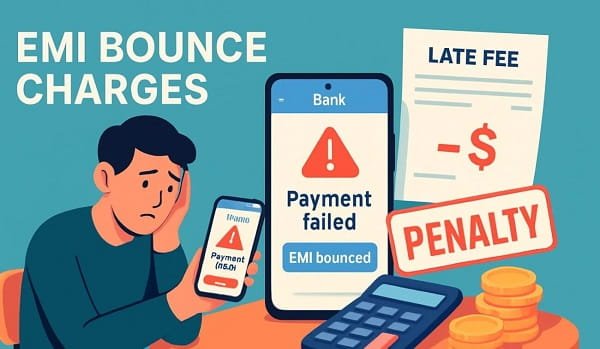
An EMI bounce occurs when your bank account does not have sufficient funds on the EMI due date and the automatic deduction instruction — ECS, NACH, or standing instruction — fails to execute successfully. Beyond the obvious concern of a missed loan payment affecting your CIBIL score, EMI bounces trigger a cascade of charges from multiple parties simultaneously that can add up to a surprisingly large financial penalty. Understanding exactly what happens during an EMI bounce, how to handle the situation immediately, and what systematic measures prevent recurrence is essential knowledge for every loan holder in India.
What Happens When an EMI Bounces?
When your EMI bounces, the following sequence of events occurs almost simultaneously. Your bank charges a bounce fee for the failed ECS or NACH instruction — typically ₹300 to ₹700 per bounce depending on your bank. Your lending institution charges a separate bounce penalty — typically ₹200 to ₹1,000 depending on the lender and loan type. A late payment fee or penal interest begins accruing on the overdue EMI amount — typically 1–3% per month on the outstanding amount or a flat late fee depending on the loan agreement. If the EMI remains unpaid for 30 days, a late payment default is reported to credit bureaus including CIBIL, Experian, Equifax, and CRIF, immediately and adversely affecting your credit score. Multiple bounces in a year can result in the lender classifying your account as irregular, potentially accelerating the entire loan to become payable immediately under default provisions in your loan agreement.
Typical EMI Bounce Charges in India
Bank charges for ECS or NACH return: ₹300–₹700 per instruction. Lending institution bounce penalty: ₹200–₹1,000 per bounce. Penal interest on overdue amount: 1–3% per month or 24–36% per annum equivalent. Some lenders charge a separate “overdue handling charge” for accounts that require manual recovery intervention. For a modest personal loan EMI of ₹10,000, a single bounce can result in total charges of ₹1,000–₹2,000 — effectively increasing your cost for that month by 10–20% beyond the EMI itself.
What to Do Immediately After an EMI Bounce
Step 1 — Pay the Overdue EMI Within 24–48 Hours The most critical immediate action is paying the bounced EMI through an alternative payment channel as quickly as possible — ideally within the same day or the next business day. Most lenders provide multiple payment options: NEFT or IMPS transfer to the loan account, payment through the lender’s mobile app or website, UPI payment, or visiting the nearest branch for cash or cheque payment. The faster you pay the overdue EMI, the smaller the penal interest accrual and the better the impression created with the lender’s account management system.
Step 2 — Confirm Total Amount Payable Including Charges When making the payment, confirm with the lender’s customer service the exact total payable — the bounced EMI amount plus any accrued bounce penalty, penal interest, and late fees. Making partial payment that leaves any outstanding charges unpaid is treated as continued default in most lender systems. Request a written or digital confirmation of total dues before making the payment.
Step 3 — Request Waiver of Bounce Charges for First Occurrence If this is your first EMI bounce and your overall account has been regular, contact the lender’s customer service and politely request a waiver of the bounce penalty charges. Many banks and NBFCs have internal policies allowing one-time waiver of bounce charges for otherwise regular accounts experiencing a genuine isolated cash flow issue. This is not guaranteed but succeeds frequently for accounts with strong repayment history. Document your request and any waivers granted.
Step 4 — Inform Your Lender About the Cause If the bounce was caused by a specific identifiable event — delayed salary credit, a bank system issue, or a genuine one-time financial disruption — informing the lender proactively creates a record of good faith engagement. Lenders distinguish between communicative borrowers experiencing temporary difficulty and silent defaulters — the former receive significantly more flexibility in collections approach.
Step 5 — Repair the CIBIL Impact If the bounce resulted in a late payment being reported to credit bureaus, you cannot erase it from your credit history — but you can mitigate its impact. Pay the overdue immediately and ensure subsequent EMIs are paid without exception for the next 12 months. A single late payment’s negative impact on your CIBIL score diminishes over time — especially when surrounded by consistent positive payment behaviour. Request a No Objection Certificate or clearance letter from the lender confirming the account is regular after the bounce is resolved.
How to Systematically Avoid EMI Bounces
Maintain a Minimum Buffer in Your EMI Account: The most reliable prevention is maintaining a consistent minimum buffer balance in the account linked to your ECS or NACH instruction — typically 1.5 to 2 times your monthly EMI total above your normal operating balance. Treat this buffer as untouchable emergency funds specifically reserved for EMI protection.
Set EMI Date to Match Your Salary Credit Date: If your salary is credited on the 1st of each month, set your EMI due dates for the 5th or 7th to allow 4–7 days for salary processing and credit. If your EMI date currently precedes your salary credit date, request a due date change from your lender — most lenders accommodate one-time due date modification requests for customers with regular accounts.
Set Up Calendar Alerts Three Days Before EMI Date: Mobile calendar reminders three days before each EMI date allow you to verify sufficient balance and transfer funds from savings or liquid investments if needed. This three-day window is typically sufficient to address any foreseeable shortfall without triggering a bounce.
Maintain a Separate EMI Account: Consider maintaining a dedicated savings account specifically for EMI deductions — separate from your primary spending account. Transfer the exact total monthly EMI amount into this dedicated account immediately upon salary receipt. This physical separation prevents accidental spending of EMI funds and eliminates the most common cause of insufficient balance bounces.
Set Up Alerts for Low Balance: Register for SMS and app-based alerts from your bank that notify you when account balance falls below a threshold you set — for example, ₹5,000 below your total monthly EMI obligations. These real-time alerts provide advance warning to take corrective action before the EMI date arrives.
Frequently Asked Questions
Q: How many EMI bounces before a loan becomes an NPA?
A: Loans are classified as Non-Performing Assets (NPA) after 90 days of default — equivalent to approximately 3 consecutive unpaid EMIs.
Q: Can I change my EMI date to avoid bounces?
A: Yes — most lenders allow one EMI date change request. Contact customer service and request alignment of the EMI date with your salary credit pattern.
Q: Do EMI bounces affect my CIBIL score immediately?
A: Credit bureaus are typically updated monthly — a bounce becomes a score-impacting event if the EMI remains unpaid for 30 days. Paying within a few days of the bounce date minimises the credit impact.
Q: Is there a maximum number of bounce charges a lender can impose?
A: IRDAI does not govern this for bank loans — RBI regulates banking charges. Check your loan agreement for the specific bounce penalty provisions applicable to your loan.